Put the Fixed Points First — Work Gets the Gaps
Published · Updated · Canvas Tasks
The list for today is four lines long: finish the deck, review two pull requests, call the supplier back, book the flights. It takes three minutes to write and looks reasonable. What isn't on it is the school pickup at half past three, dinner, and the hour you'd have to be asleep for tomorrow to be any good — left off not because they were forgotten but because they didn't seem like planning. They're just what happens.
By six the deck is still open — there was always one more pass on a slide that was already finished — so it takes the evening; the other three get done around it. Someone else collects the children. Dinner is eaten standing up, and bedtime lands forty minutes late. Nobody decided any of that. It was what was left to give.
The fixed points of the day are the parts you can't move without someone paying for it — waking, meals, the commute, a pickup, the hour you need to be asleep. Left off the page they get moved anyway, quietly, every time work runs long: the meal gets worse, someone else covers the pickup, sleep pays at the far end. Most planning runs in that direction by default, scheduling work first and expecting life to fit into what remains. Planning around fixed points reverses the order — write down what can't move cheaply, give work the gaps in between, and moving a point becomes something you decide rather than something you discover.
None of this adds anything to the day. It changes the order in which two kinds of things get written down.

The points go down first. What's left between them is what there is.
Work first, life in the leftovers
Most planning starts with work, because work is the part that feels like it needs planning. Meals, the commute, the pickup, sleep feel automatic, so they stay outside the plan while it fills up with everything else. The document that comes out is a description of a day with most of the day missing.
When a task runs long, no line says the meal starts here or the children are collected at this hour, so the overrun meets no resistance and simply extends.
The obvious repair is to write the work down more precisely — the whole day assigned, hour by hour. That doesn't hold either: the grid gets built in the morning, by the version of you who knows the least about the afternoon it's assigning, which is why it falls apart. What's left after that is the question here. If work can't usefully be placed in advance, is there anything that can?
The measured part and the guessed part
The two halves of a day's plan are not the same kind of thing, and only one of them is knowable in the morning. Between waking and sleeping there are meals, a commute, someone to collect; the hours work can have are the spaces those leave — the containers it has to fit into. Those containers have lengths, and the lengths don't flex to cover a long morning. Move the pickup itself and the container moves with it — but you're the one moving it, and you know it at the time.
The other half is a guess, and the guesses lean one way. People plan work optimistically as a matter of course — the planning fallacy names the tendency to expect a task to take less than it takes, and the expectation survives years of evidence to the contrary. Work also fills what it's given: with nothing pressing from the other end, the deck gets one more pass at a slide that was already finished.
What changes when the points go first
Written down, a fixed point changes what an overrun is allowed to do. A task list holds the things you mean to do; the pickup and the meal get paid for whether you mean them or not — on time, or in quality, or by someone else. Left off the page they get paid quietly, because a part of the day with no line on it can be spent without anyone deciding to spend it. Give it a line and the same overrun meets an edge that has to be crossed on purpose — and which side gives becomes a choice instead of a default.
The mechanism is unglamorous. A written point doesn't stop anything; it puts the price on the screen next to the work — another ten minutes, or the meal. Whether the extra pass survives that comparison is now an open question, which it wasn't an hour earlier, when nothing was being weighed against it.
Fixed points aren't tasks — nothing to complete, nothing to sequence. Writing them down doesn't say what to work on, only how much room there is to work in. The points get times. The work never does.
How to plan around fixed points
Planning around fixed points takes four rules, and the third is the one that decides whether this is a plan or a grid.
-
Write the points down before the tasks. Put a time against each, and count each meal on its own — "meals" as one line erases the edges that divide the day. A typical day comes to five: breakfast, lunch, a pickup, dinner, bedtime. A meeting someone else set belongs here too; the test isn't whether something is work, it's whether moving it costs someone.
-
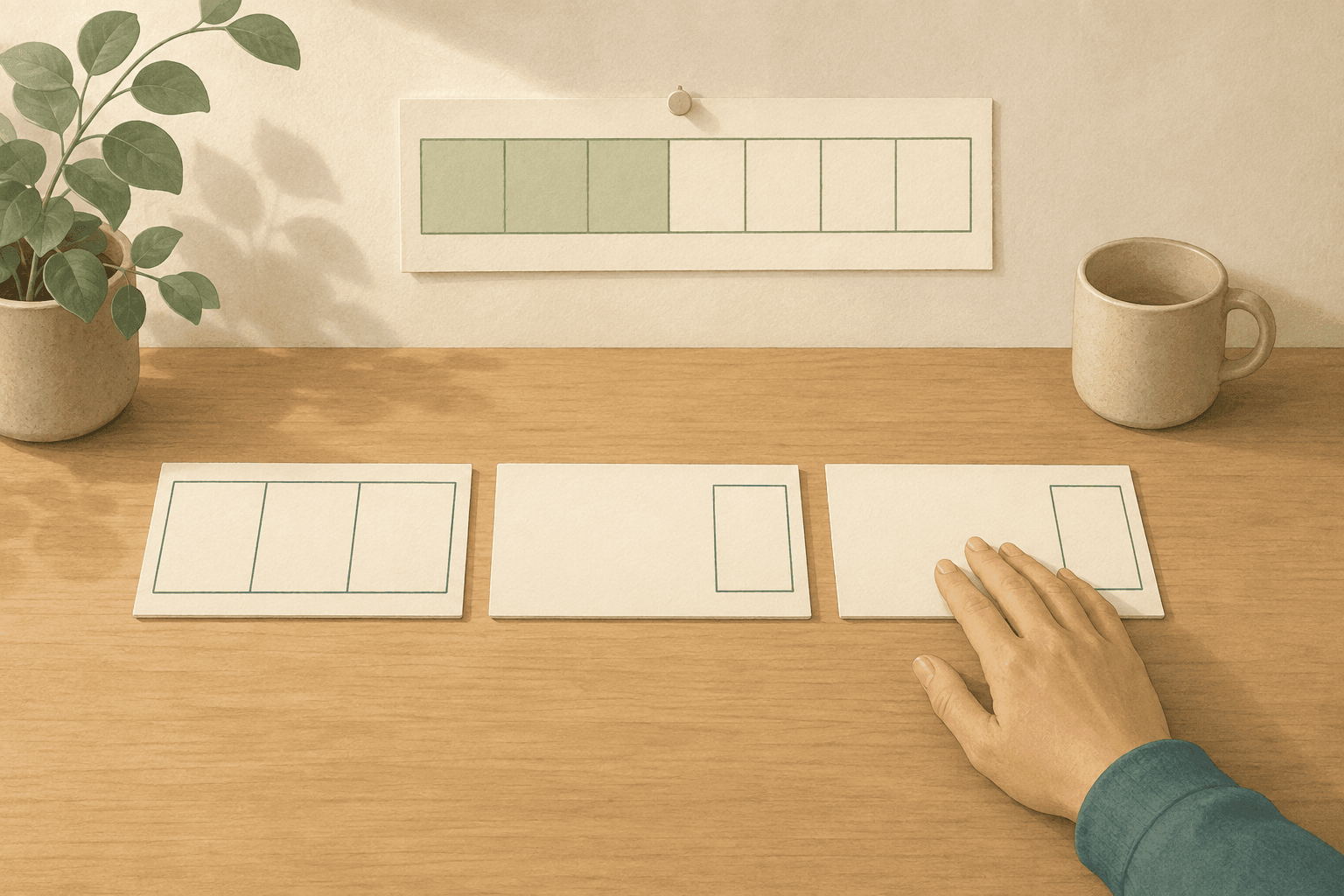
Count the room before you count on it. Five points leave four containers between them; add up the ones that can hold real work and hold that total against the list. What comes out isn't a schedule but an answer to one question: does the day have room for all of this?
-
Choose at the start of each container, not in the morning. Assigning every task to a container over breakfast is the grid again, built by the person who knows the least about the day. When a container opens, pick what fits its length and the energy you actually have in it — the subject of energy-based task management. The morning owes you a count, not a schedule.
-
Decide what gives at each point. A point arriving doesn't end the work; nothing does except you. What it supplies is a moment when both prices are visible — the task can give, or the point can, and on some days the point should. Choosing when to stop is otherwise a skill of its own, one that evening work needs badly.
Take the day from the top of this article through them.
The points go down first, each with a time on it: breakfast at nine, lunch at half past twelve, the pickup at half past three, dinner at half past six, lights out at half past ten.
The four containers left aren't the same kind of thing. Two are long and uninterrupted — three and a half hours before lunch, two more between lunch and the pickup. The other two are clock-hours that aren't really yours: the stretch from the pickup to dinner has children in it, and the one after the table is cleared runs out before the clock does. An hour each, at best.
Then the count. Seven and a half hours of room; on the list, the deck at five hours if it behaves, an hour of reviews, half an hour for the supplier, an hour of comparing flights. Seven and a half against seven and a half isn't a full day — it's a day with no slack, and the deck has never once behaved. So the flights become tomorrow's before anything starts.
The morning container opens and the deck goes into it: biggest thing, biggest container. At lunch it isn't finished, and the extra pass at the finished slide is still on offer. Both prices are visible now: keep going and eat badly, or close the laptop and lose the thread. You eat, and the extra pass doesn't survive the comparison — which is the hour the first version of this day never got back.
The stretch after lunch goes to the deck as well — chosen at half past one, not at breakfast — and it finishes there, half an hour over estimate, inside the slack that dropping the flights bought. Then the pickup, where the point could give: a text would get the children collected and buy two more hours. The price is known, and today it isn't worth paying, so you go.
The hour before dinner takes the supplier call, because the office closes and nothing later will reach it. It runs over, and this time the point gives: dinner goes back twenty minutes, said out loud to the person cooking — a different thing from dinner going back twenty minutes because nobody noticed.
The reviews take the hour after the table is cleared: the evening still holds work, just the work that was left over, not the work that overran.
That day finished three of four, with dinner twenty minutes late by agreement and bedtime on time, and the line that didn't happen was chosen before nine in the morning. The first version finished all four and paid the difference with someone else's afternoon, a meal eaten standing up, and forty minutes of sleep — at a price nobody quoted. The order doesn't decide which trade is right. It decides whether you make it.
"But the work still has to fit somewhere"
Changing the order doesn't create time. A day whose work exceeds its room is over-committed in any arrangement, and putting the meal on the page first won't finish the deck. The objection is correct, and it names what the change of order is for.
A work-first plan hides the shortfall. Everything fits on a page with no edges, so the day looks achievable until the middle of the afternoon — and the discovery arrives when the fewest options are left.
A points-first plan won't fix the estimates — the deck will still look like five hours in the morning. What it fixes is the other half of the comparison: the room is a total you set rather than one you hope for, so a day with no slack in it says so before it starts. What doesn't fit gets deferred, delegated, cut down, or set aside on purpose — while there's still a choice about which part goes.
That's the whole of the method, and it's why it survives the ordinary kind of bad day: the one where something simply takes longer than it should. The parts you can't move cheaply are settled before any of the work is chosen, so a plan that starts there can be wrong about a task and still be right about the day.
A plan that starts from the work has already decided who pays. It just hasn't told you yet.
Frequently asked questions
Do the points need to be the same times every day?
No, and most people's aren't. What has to be steady is the practice of writing down the day's immovable points before the work, not the times themselves. A day with a different school run and a later dinner still yields containers you can count — and the count is the output, so it is supposed to change with the day.
Are fixed points the same as daily non-negotiables?
No. Non-negotiables are habits you choose and defend — a workout, a reading hour — and they compete for gaps like any other work. Fixed points exist whether or not you defend them. The distinction matters in planning: non-negotiables go into the gaps; fixed points define where the gaps are.
What if my day has almost no fixed points?
A day working from home can feel shapeless — but sleep and meals are still there, and four points leave three containers with edges between them. The risk of a shapeless day isn't too little structure to plan around; it's that work meets no edge at all, and expands until something outside the plan stops it.
What if the points themselves are what's too much?
Then planning around them has done its job early. Counting the room works the same whether the shortfall sits in the work or in the commitments, and a day whose fixed points leave two usable hours is telling you something a task list never would. What to do about that is a separate decision, made in the morning.