Being Behind Is a Judgment, Not a Measurement
Published · Updated · Canvas Tasks
It's Thursday morning. The week has three goals on it, none of them ticked, and the panel above them has changed colour to say so: This week's goals are falling behind. Zero of three, with four days left.
Then you read the three lines. Run three times. File the tax return. Read the report before Monday's meeting.
Only the first one is behind.
A tracker can measure two things about a goal — how much of the period has gone, and how many items are ticked — and calling the distance between them "behind" is a judgment laid on top of the measurement. The measurement is sound. The judgment holds only if the goal was going to accumulate steadily across the period, and plenty of goals don't: they sit at zero and then land, once, near the end. Nothing in a line of text tells the tool which kind it is holding.
Telling which of the three is actually late takes you about a second. That distinction is not available to the tool at all.

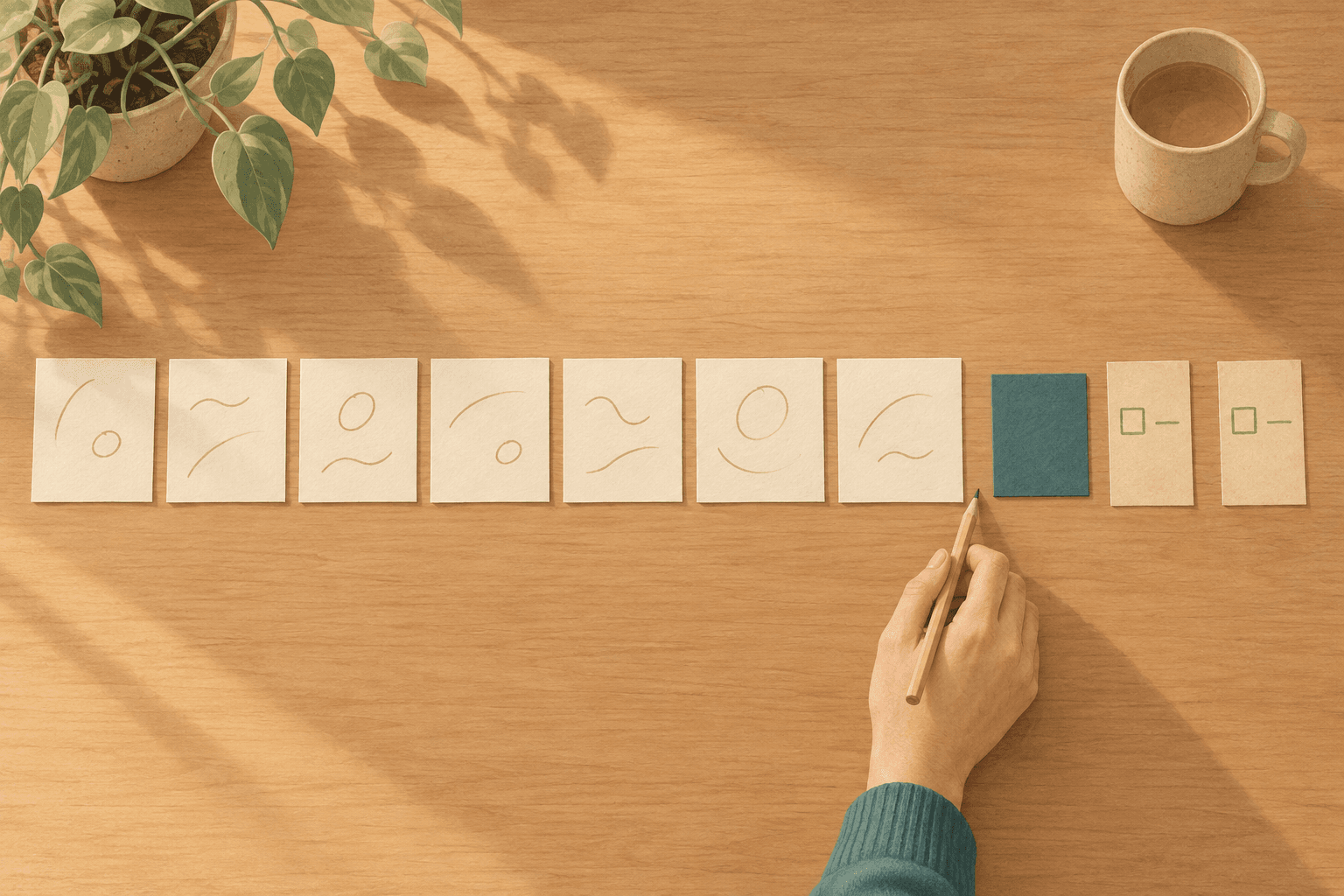
The same blank face, for different reasons.
The week that looks like a failure
A goal count is the same number whatever the goals are made of. Three lines, none ticked, three days gone: that is the whole of what the tool has, and from it comes a verdict about your week. The verdict is reached honestly — how much of the period has passed, how much of the list is done, the distance between them — and it is wrong about two of the three lines, because neither of them was ever going to be ticked by Thursday morning.
The cost of being wrong that way isn't the moment of irritation. A warning that misfires teaches you to discount it, and the discount gets applied to the whole class of warning rather than to the particular one that misfired. Sorting the true from the false would mean checking each, which is the work the warning was there to save. Before long, the panel is furniture.
The other response is quieter and costs more: not discounting the warnings but removing them. Consider someone who notices the misfires and turns the warnings off: they have also turned off the one about running three times a week — the line where the count meant exactly what it said, and where hearing it on Thursday would have left four days to act.
Neither response is a mistake. Both are what happens when one signal carries good and bad information at the same volume. Whether a verdict like this one greets you in the morning or waits inside a screen you chose to open changes what it costs when it's wrong. What it is made of decides whether it should have been said at all.
Goals have shapes
Goals come in at least two shapes, and which one you are holding decides what an unfinished period means. A steady goal produces its value along the way: run three times this week, write two sections, call four customers. Each unit is real when it happens, and a day you skip doesn't come back — so Thursday with none done is a genuine shortfall, because three runs now have to fit into the four days that are left. A landing goal produces nothing until it completes: file the return, give the talk, move house. It sits at zero for as long as it takes and then goes to one.
A steady goal sitting at zero of three on Thursday is genuinely behind. A goal that lands once, on Friday, is also at zero of three on Thursday — and it is exactly on schedule.
What the tool has in front of it is identical in both cases: a line of text, a checkbox, and a calendar. It can count the ticks and work out how much of the week has gone. Neither number carries the shape. The shape lives in what the words refer to — in whether the work can be done in pieces at all — and that is the one part no field holds.
The assumption underneath the verdict is not a careless one. Much of what people track really does accumulate — hours, workouts, pages, calls — and for those, elapsed time is a fair stand-in for expected progress; a tool that stayed silent until the final day would be useless for them. What it can't do is notice when the assumption doesn't hold.
Decide what the middle means
Deciding what the middle of a period means — how much of a goal should be done halfway through, or whether the question applies to it at all — is a step you take once, at the moment you write the goal down, when you know more about it than you ever will again.
Two sentences are enough to sort almost anything:
By Thursday, two of these should be done. — that is a rate, and a rate can be behind.
This one is done on Friday or it isn't done at all. — that one has no middle to be behind in.
Once the shape is settled, four things follow from it.
-
Write the shape beside the goal. One word — steady or landing — in the margin, on the card, wherever the goal lives. Recording it later means reconstructing a decision you already made and have since forgotten; recording it now costs a second, while the reasoning is still in front of you. The word is also what makes the rest of the list readable on a bad Thursday: a list where every line carries its word can be read for what is actually late.
-
For a steady goal, name the amount you expect by mid-period. Two of three by Thursday, six pages by Wednesday. Without that number, "behind" has nothing to be measured against and reduces to a remark about the calendar. The amount is worth setting against the week you actually have rather than an average one — which is a question about the energy the week is going to give you.
-
For a goal that lands, look for the next move instead of the count. Progress here is invisible by construction: the count tells you nothing until the day it tells you everything. What can be checked is whether the next step has a place — an hour set aside, a document open, a form downloaded. A landing goal with nothing scheduled is the one to worry about; no completion percentage will ever show it.
-
A goal whose shape you can't name is often too big to be a goal. Sort out the website has no shape because it is several goals wearing one line, some steady and some landing. The fix isn't a better label, it's splitting it until each piece has one. Shapelessness is a useful signal in itself: it says the deciding hasn't happened yet.
"But I want to be warned"
Wanting to be warned is the right instinct, and nothing here argues for a tool that stays quiet while a week goes wrong. Warnings work. Being told on Thursday that a running goal has had no runs is exactly the intervention that saves it, and a system that never says anything leaves you to notice everything yourself, which is the condition you were trying to get out of.
The case for a warning is that it saves you the cost of checking. A warning whose premise you have to verify every time has already spent what it was meant to save.
So the repair isn't to switch the warnings off. It's to supply the premise they were missing — the shape, and for steady goals the amount expected by now. A goal carrying those can be warned about correctly, and the warning arrives meaning something. A goal without them can still be shown, counted, and reviewed; it just shouldn't be the thing that interrupts you, because there is nothing behind the interruption except a subtraction.
What Canvas Tasks shows and what it doesn't
This is where Canvas Tasks comes in. A goal is one line of text and a checkbox: no progress field to fill in and no field for the shape either, so the steady or landing word has to live inside the line of text with everything else. The app is working from the two numbers this article began with: days elapsed, items ticked. What it does with them is show the arithmetic and stop there.
The distance between those numbers is calculated and shown. The heading over each week and each month carries a badge — On track, Watch, or Behind — and the badge is always there, whether or not you have asked for anything.
The rule that produced it is written into the tooltip rather than left in the code, so it can be read and disagreed with. Subtract the completion rate from the share of the period elapsed: more than 40% is Behind, and 20 to 40% is Watch, the narrower band beneath it.
Today isn't counted as elapsed, and for a goal still at zero the gap is simply the elapsed share: Wednesday has closed two of seven days — 29%, which is Watch — while Thursday has closed three, or 43%, which is where Behind starts.
What doesn't happen by default is the interruption. A panel like the one this article opened with is something you switch on. The notification and the banner on the Today home are one switch, and it ships off: the settings screen says Off by default under a toggle labelled Notify goals falling behind.
That wasn't the original setting. It was on by default, and it was turned off in August 2026, prompted by a complaint that had nothing to do with defaults: people couldn't tell what rule was producing the warnings. The fix was to write the rule down where it could be seen — and once written down, it was plainly not a rule that fitted every goal, because some goals only complete at the end of the period they belong to. Publishing the rule is what made the default indefensible. Anyone who already had the warnings on kept them; only the starting position changed.
Projects, which are a Pro feature, keep the equivalent notification switched on, and the difference is instructive. What fires it there is not a pace calculation at all but the absence of any movement — no child task touched for fourteen days — which is the landing goal's own test in the tool's hands: not how much is done, but whether anything has been set up next. That it misfires less is the reason on record for keeping its default.
None of this makes a bad week better. It means the app tells you the two things it knows and leaves the shape to the only party who has it.
Frequently asked questions
Who decides the shape when the goal came from someone else?
Whoever set it usually knows, and asking costs one message. A goal handed over without its shape is missing the part that makes progress readable, so the question is worth asking when it is assigned rather than in the middle of the period, when the answer arrives too late to change what you would have done.
What about a goal that is both steady and landing?
Some are: a report written a section at a time and submitted once. Treat it as steady while you are producing and as landing in the final stretch. The moment the remaining work is a single indivisible act, the count stops carrying information, and the only useful question is whether that act has a place in the week.
What if the shape changes partway through?
Rewrite it, and treat that as ordinary rather than an admission. Work sometimes turns out to accumulate steadily when you expected a single delivery at the end, or the reverse. The word you wrote beside the goal records what you knew at the time, not a promise — and a stale one produces exactly the misreadings it exists to prevent.
Does the same reasoning apply to a deadline?
No. A deadline is a point rather than a rate: it has either passed or it hasn't, and the shape of the work doesn't change that. Pace judgments are about how work is distributed inside a period. A missed deadline is a fact; being called behind halfway through a week is an interpretation.
How do I reset a goal I've fallen short on?
Change the amount you expect from the days that are left to a number you would still set if you were writing the goal today. That is a different act from resolving to work harder, and it's the one most people skip: carrying the original figure to the end of the period guarantees the record reads as failure whatever happens.