A Maybe Is Not a Miss
Published · Canvas Tasks
It's nine in the evening and today's list has two things left on it. One is the invoice you told a client would go out today. The other is half an hour of guitar practice. Both sit there with an empty checkbox, in the same grey, and the list reports the same thing about each: not done.
Only one of them was a promise.
A to-do list can record only one kind of thing: something you have agreed to do. Put anything else on it — the chapter you'd like to read, the drawer you'd like to clear — and by evening it reads back the way the missed deadline does: undone. So the cheapest move is to stop writing those things down at all, and the list becomes an accurate record of obligation and nothing else. What fixes this is not a priority field. It is a second section with different accounting: one that counts, and one that doesn't.
The list that only holds obligations
The things that get left off today's list are often the ones you were looking forward to. Not because they don't matter, and not because you forgot them. Writing one of them down has a price, and the price comes due in the evening.
Consider someone who adds read a chapter to Monday's list. The day fills up the way days do, and at nine o'clock there are two unfinished items instead of one. Nothing about the invoice has changed. The evening is simply one line worse than it would have been, and the only thing that made it worse was the act of writing down something they wanted. By Thursday they have learned. The chapter stays in their head, where it costs nothing and gets read about as often as before.
This is the opposite of the failure everyone talks about. The familiar broken list is the one that has grown past anything a person could do in a week, where opening it means facing forty items and picking one — a problem of too much arriving at once. The list described here has the reverse shape. It is shorter than the day it stands for. Every line on it is work someone is owed, because that is the only kind of line that survives the accounting.
A list can be completely accurate and still be a poor record of your day.
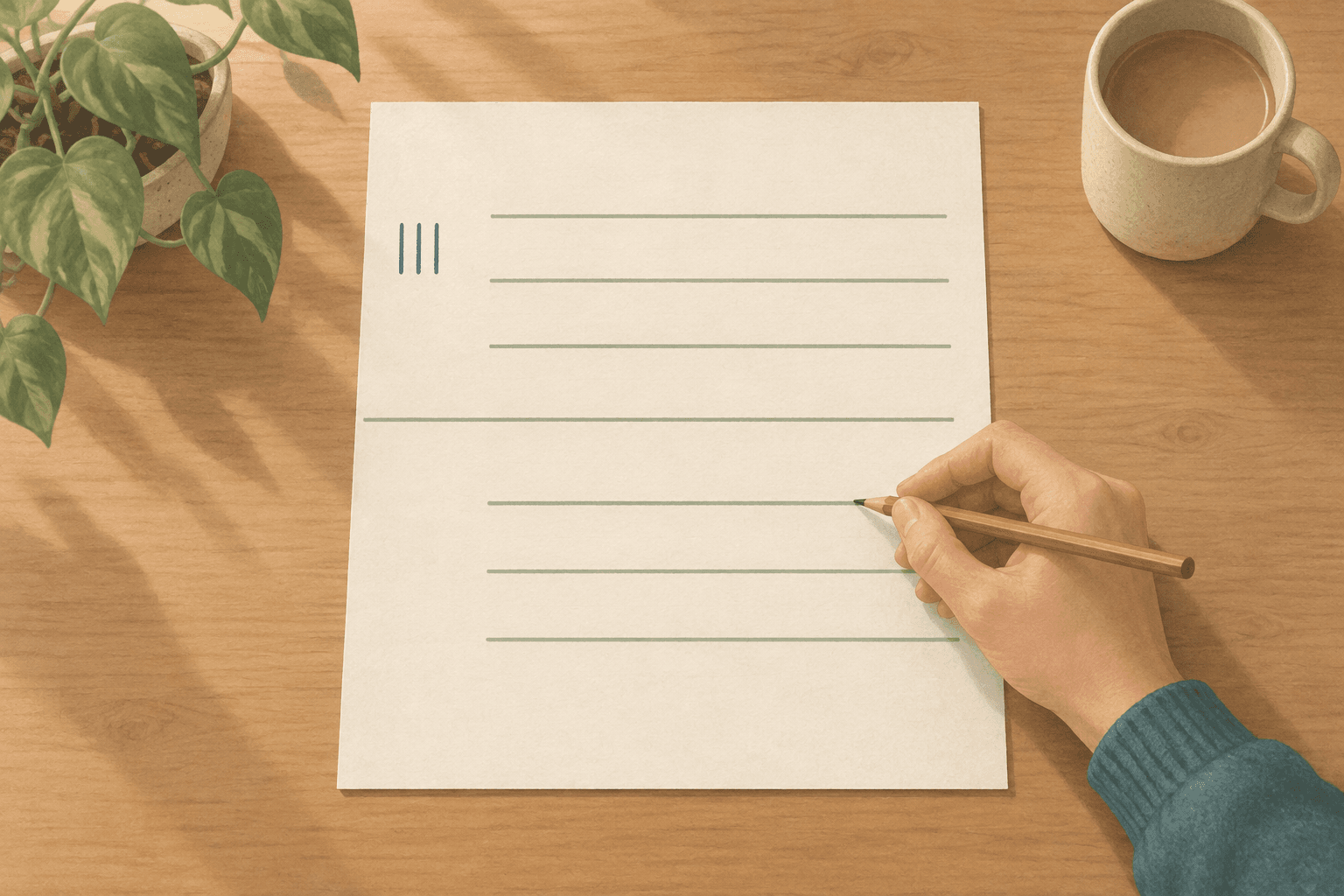
Same paper, same lines, one of the halves counted.
Two kinds of unfinished
Unfinished arrives in two kinds, and a checkbox renders them identically. The first kind is a commitment that didn't happen: someone is waiting, or a date has passed, or you will have to send a message in the morning explaining. The second kind is a hope that ran out of room. The day was full, and what was left over was left over.
The first kind carries information — something in the plan didn't hold, and it's worth knowing which thing. The second carries almost none. It says the day had a size, which you already knew at breakfast.
What a list has in front of it, on paper or on a screen, is a row with an empty box. Which of the two kinds it belongs to lives in how the line got there — whether anyone was told about it, whether anything downstream depends on it, whether you would describe not doing it as breaking your word. None of that is stored anywhere. It is the same gap that opens when an app calls you behind on the strength of a date and a tick count.
The usual fix for a list that treats everything alike is to rank it. That fix doesn't reach this problem.
Ranking sorts one list; it doesn't give you a second kind of unfinished.
A tier is a statement about order, and order is answered by the time you start working. It says nothing about what an empty box means at the end of the day. The lowest-priority item you didn't get to is still an item you didn't get to, sitting in the same column, counted in the same total. What's missing isn't a rank. It's a second column in the ledger.
Give optional work its own accounting
Splitting today's list takes one horizontal line and a decision about what gets counted. On paper it is four rules.
-
Write the two kinds in separate places. Above the line goes what you have taken on: work you would have to explain if it didn't happen. Below goes what you'd reach for if the day goes well. The split isn't by importance — the invoice and the guitar practice sat there the same size, and only one was promised. It's by whether anyone, including you, has been told.
-
Count only the top half. Whatever number decides how the day went — items ticked, a fraction, a feeling at bedtime — draw it from above the line and nowhere else. A total is what turns a blank box into a shortfall: two of four means two are still open, and the guitar practice is one of them. The half with no total stays cheap to write in.
-
Let the bottom half end empty. Anything below the line you didn't reach doesn't roll into tomorrow. If you still want it, write it again. Rewriting is the test: a hope worth choosing twice costs one line; one that isn't disappears. Carried forward instead, it stops being something you picked this morning and becomes something that has waited — and waiting is what makes a line look owed.
-
Move things up, not down. When a hope turns into a commitment — you mention it to someone, or you decide it's happening today — move it above the line and count it from that moment. The upward move is ordinary. The downward one isn't its mirror image: it withdraws an agreement, so the question is about the person you told, not about where the row sits.
With a notebook this is a ruled line halfway down the page. The rules that matter are the second and the third, and both are about restraint: the discipline is in the total you don't write and the line you don't carry over. Which of the things above the line to start on is a separate question, answered best by the energy you actually have at the time.
"But isn't this just a priority system?"
A priority system ranks one list, and this splits one list into two halves that are scored differently. The distinction sounds small until you look at the established answers, every one of which is aimed at the other failure — the day carrying more than it can hold — and solves it by taking something off the page.
One family deprioritizes. Michael Linenberger's advice is to cut hard and continuously, because "if your task list is too big and poorly prioritized — if tens or even hundreds of items are critical — you'll abandon the list" (Goodreads). Leo Babauta's Most Important Tasks works the same way: a few things are today's, and the rest wait in the backlog. Mark Forster's closed list, from Do It Tomorrow, draws a cutoff instead — once the day's list is closed, nothing else joins it.
Taking it off the page is the right move for work that belongs further out than today. It isn't available for the thing you might do this evening, which has to be somewhere you can see it to be reached at all.
Another family limits the quantity. The 1-3-5 method caps the day at nine items, one large, three medium and five small (Todoist). It is a good answer to overcommitment. What it doesn't do is distinguish work you promised from work you hoped for: all nine are the day's tasks, and the instruction for what's left at the end is to "decide what to do with anything you didn't get to" — prioritize it tomorrow, return it to the main list, or delete it. Unfinished stays a single category with a single set of options.
None of those is wrong, and none of them is answering this question. Quantity, cutoff, order — three different levers, all applied before the day starts. The lever here is applied at the end of it, to the meaning of a box with no tick in it.
What Canvas Tasks counts
This is where Canvas Tasks comes in. Today's list is two sections: To do holds what you've taken on, and Want to do sits beneath it for what you'd reach for if the day leaves room.
Only one of them carries a number. The To do heading reads To do 2/4; the Want to do heading has no count at all, and no total appears beside it anywhere in the day. That asymmetry is the whole feature — a count on the lower section would make it a second place to fall short, which is the pressure the split exists to remove.
The rest of it follows from the same rule. The order is fixed — To do first, Want to do after it, regardless of typing order — and starting a focus session draws from that same order, so a hope never arrives ahead of a promise.
Rows move between the sections in either direction, by dragging or through Move to Want to do and Move to To do. Moving one down is not blocked or slowed: the rule about that direction is a rule about what the move means, and which half a thing belongs in is a judgment only the person who wrote it can make.
Nothing crosses into tomorrow on its own. Carrying an item forward is a menu action you choose — Copy to tomorrow or Move to tomorrow — and it keeps the section the item was in, so nothing accumulates into an obligation while you aren't looking. The lower section is open by default, because the whole point is that writing a hope down should be cheap, and folding it away puts a click in front of every one of them. You can collapse it anyway, and each device remembers whether you did.
One honest limit: on the free plan, the five-a-day cap counts both sections together, so a Want to do item uses the same allowance as a to-do. (The cap is lifted on Pro.) What the split removes is the cost at the end of the day, not the cost of the row itself.
The list still can't tell which kind of unfinished it is looking at. It just stops reporting a number for the half where the question doesn't apply.
Frequently asked questions
Should the optional section have a limit?
Not a number, no. A cap turns the second half into a second quota, which is the thing it exists to avoid. What does help is a floor on the first half: if the committed section is long enough that you know it won't finish, the problem is upstream of the split, and no amount of optional space fixes it.
What if something I wanted to do turns out to be urgent?
Move it up and treat it as committed from that moment. The point of the split is not that the bottom half is unimportant — it's that nothing there was promised yet. Promoting it is a decision you make on purpose, which is exactly what a list should record.
Doesn't this just hide work from myself?
The optional section stays visible; it simply isn't scored. Hiding would mean removing it from view, which creates the background worry that you've forgotten something. What changes is the accounting at the end of the day, not whether you can see what you wrote.
How is this different from a someday list?
A someday list holds work with no date attached, reviewed occasionally. The optional section belongs to one particular day and empties with it. If something keeps reappearing there for weeks, that's a signal it wants a date or a place further out, not a permanent seat on today.